__________________________________________________________________________________________________________________________
__________________________________________________________________________________________________________________________
__________________________________________________________________________________________________________________________
__________________________________________________________________________________________________________________________

Friday, February 25, 2022

TtD supplement #209 : seven questions for Nate Logan

Nate Logan is the author of Small Town (The Magnificent Field, 2021), Inside the Golden Days of Missing You (Magic Helicopter Press, 2019) and Apricot (above/ground press, 2022). He teaches at Franklin College and Marian University.

His poems “I Can Feel Evil Creeping In,” “Self-Portrait at 37” and “Arbor Day” appear in the thirty-second issue of Touch the Donkey.

Q: Tell me about the poems “I Can Feel Evil Creeping In,” “Self-Portrait at 37” and “Arbor Day.”

A: I don’t know much, but I’ll tell you what I do know.

“I Can Feel Evil Creeping In”: This poem is for my friend and fellow poet, Jessie Janeshek. While I borrowed the title from a song, something is usually creeping in in Jessie’s poems, which I enjoy. “James Dean” was on the cover of her last chapbook, Channel U, and is one of the few famous Hoosiers who isn’t embarrassing.

“Self-Portrait at 37”: I was thinking of David Berman’s “Self-Portrait at 28” when I wrote this.

“Arbor Day”: To my knowledge no one has written a poem about Arbor Day, so I thought I’d be the first. Thanksgiving, Christmas...these days have enough.

Q: How do these poems compare to some of the other work you’ve been doing lately?

A: In terms of form I’d say they’re right in line. I’ve been in a prose poem mode for a little over a year now.

Q: What prompted you into this stretch of the prose poem? And what is it about the form that appeals? What do you feel the prose poem provides or allows that might not be possible otherwise?

A: I’d been writing prose poems since graduate school, but only occasionally. Post the publication of my first book, I noticed that I’d written a handful of prose poems that were yet to be collected. I read some classics in the genre (e.g. Charles Simic’s The World Doesn’t End) and consciously decided to attempt to write enough of them for another manuscript (which I have!). It was also during this time I was introduced to the work of Lesle Lewis, which has nudged me into a longer term relationship with the form than I initially planned. I may never go back.

A lot of my feelings on the prose poem can be summed up in this quote by James Tate:

“The prose poem has its own means of seduction. For one thing, the deceptively simple packaging: the paragraph. People generally do not run for cover when confronted with a paragraph or two. The paragraph says to them: I won’t take much of your time, and, if you don’t mind me saying so, I am not known to be arcane, obtuse, precious, or high-fallutin’. Come on in...”

Q: Is there a difference in the way you approach the prose poem against any other particular form? What is it that you think the form provides?

A: I’d say the only difference is that I follow all the rules: the prose poem is one paragraph (or more) composed of complete sentences. I bend with other forms. For example, I’d keep a sonnet at 14 lines, but ditch the iambic pentameter and rhyme scheme.

As for what the form provides, I think the prose poem expands the possibilities of what poetry can be. And because its hallmark is forgetting the tool of line break in the garage, it will always be inherently subversive, which surely appeals to the poetically-inclined.

Q: With a handful of published poetry chapbooks and a trade collection under your belt, how do you feel your work has developed? Where do you see your work headed?

A: I think the only thing I can say for sure is that the poems are “better,” more complete, require less revision, etc. When I first started writing seriously, I often shoehorned my waking life into the work; my poems started getting better after I cut that stuff out.

I see more prose poems in the future. Maybe I’ll try a long one.

Q: Have you any particular models for the kinds of work you’ve been attempting lately, whether specific authors or works?

A: Lately, I’ve been returning to Lesle Lewis and James Tate. I particularly love the surprise, the jumps that happen from sentence to sentence in Lewis’s poetry. And the narrative impulse in Tate’s prose poems, always charming, is something I usually find myself leaning toward.

Q: Finally, who do you read to reenergize your own work? What particular works can’t you help but return to?

A: I’m going to sound like a broken record, but reading James Tate always puts some zip in my step (Distance from Loved Ones is a favorite). Michael Earl Craig’s work I’ve loved since graduate school and keep revisiting. Every autumn I reread Joy Williams (the season just feels appropriate). If I ever run for election, making Jennifer L. Knox’s “Hot Ass Poem” required reading will be my first campaign promise.

Monday, February 14, 2022

TtD supplement #208 : seven questions for Lillian Nećakov

Lillian Nećakov is the author of six books of poetry, numerous chapbooks, broadsides and leaflets. Her new book il virus was published in April 2021 by Anvil Press (A Feed Dog Book). In 2016, her chapbook The Lake Contains an Emergency Room was shortlisted for bpNichol chapbook award. During the 1980s she ran a micro press called “The Surrealist Poets Gardening Association” and sold her books on Toronto’s Yonge Street. She ran the Boneshaker Reading series from 2010-2020. She lives in Toronto and just might be working on a new book.

Her poems “How to Walk a Dog,” “Grocery Shopping on Compassion Road,” “Muskoka Weekly” and “About a Book” appear in the thirty-second issue of Touch the Donkey.

Q: Tell me about the poem “How to Walk a Dog,” “Grocery Shopping on Compassion Road,” “Muskoka Weekly” and “About a Book.”

A: The first 3 poems are part of a series I have been working on. I started with this constraint; every poem had to respond to or use as its catalyst a “How To…” manual. For example I wrote “How to Walk a Dog” after “How to Solve Physics Problems”, “Grocery Shopping… after “How to be Compassionate” and “Muskoka Weekly” after “How to Be a Canadian”.

I love these kinds of challenges. I love moving outside my immediate self, looking at things from say, a scientific point of view and then bringing it back to a particular moment or event that is relevant to me. When I was writing “How to Walk a Dog”, I was thinking how do I reconcile instantaneous velocity with walking my dog, how does this formula pertain to me, in this specific moment in time?

“About a Book” was written after I went to a dear friend’s book launch. A sentimental poem about missing someone with a bit of nostalgia mixed in.  

Q: How do these pieces compare to some of the other work you’ve been doing lately?

A: I think the difference is in the process. These pieces (excluding “About a Book”) were very deliberate, they all had a similar starting point and intent. It took me much longer to work on these pieces, since I was relying on found material (the “How To” books).  I would search out books from the public library and in some cases had to wait for the books to arrive at my local library branch. Sometimes I didn’t relate to the books, or they weren't what I thought they’d be, or they might be too technical or too flippant. So the process was very different from how I normally work.

In terms of how these pieces compare in theme to my other current work, they do overlap somewhat. Even though I was sometimes working in response to texts that were outside my field of interest or didn’t “fit” with what I am usually drawn to, I somehow managed to write my way back to myself. If that makes sense?

Q: Is “intent:” a common starting-point for how your poems emerge? How does a poem, or grouping of poems, begin?

A: No, most times it is not. More often than not, for me, a poem begins with a headline, a scene in a film, a broken robin’s egg, a visit to the emergency room with one of my kids, a scent, a snippet of overheard conversation, a memory, a walk with my dog, a nightmare, a death, a birth, anything really. What I am most excited about is how/where the poem ends. Where you begin and where you end are often two very different places. The big themes, if you want to call them that, are always there, in your subconscious, and even though you begin with a line about a magnolia tree or your son’s broken clavicle, that’s not what the poem is ultimately about, that’s not where you end up. I don’t usually sit down and think, okay, today I’m going to write a piece about climate change, or my father’s funeral. Those things might become woven into the landscape of the poem as I write. The journey is what I find so satisfying and sometimes I end up surprising myself.

Q: With six published collections and numerous chapbooks under your belt, how do you feel your work has progressed? Where do you see your work headed?

A: I definitely feel that I have a much wider lens and I don’t take myself as seriously. Not that I don’t take my work seriously, I’m just no longer that brooding, angst-ridden young poet. I can approach my work with a sense of humor and move past my own ego. The Chilean poet Nicanor Parra said, “it’s when you lose your sense of humor that you begin to reach for your pistol”. As a result, I think my work is more expansive, much deeper and hopefully more accessible.

I’ve done a lot more collaborative writing in the last few years which has included quite a bit of visual stuff. That has really opened a lot of doors for me and given me confidence to experiment more. Now, when I write, I feel like I’m creating community, I’m not writing in a vacuum. I hope I’m headed in the right direction!

Q: What kinds of collaborations have you been engaged in?

A: Prior to the pandemic, Jim Smith, Nicholas Power and I would try and get together about every 2 months or so and spend the afternoon writing together. We would use found material in both English and other languages (print, sound, visual) as a starting point and just go from there.

Most recently, Gary Barwin and I worked on a collaborative poem, duck eats yeast, quacks, explodes; man loses eye that turned into a book which Guernica is publishing in 2022. It was so much fun to work on and it took me on a wild literary journey.

Here is a short synopsis of the book:
“duck eats yeast, quacks, explodes; man loses eye is a book that traverses the 'big' questions through literary shenanigans, exploding ducks and mathematical equations. It celebrates the strange and surprising beauty of language and thinking”.
Q: You referenced this a bit earlier, but how has your collaborative work affected the ways in which you approach your solo work?

A: There is definitely a lot less self-doubt. A shift occurs when you let in other voices, boundaries are expanded, you start to work across differences in language, vocabulary, and theme and that extends to solo writing. There is always that sense that I am part of something bigger and that is very comforting.

Q: Finally, who do you read to reenergize your own work? What particular works can’t you help but return to?

A: I go through different phases. Currently I am reading Marieke Lucas Rujneveld, Ocean Vuong, Joy Harjo and Juan Felipe Herrera. I always return to Charles Olson, Charles Simic and Octavio Paz.

Thursday, February 3, 2022

TtD supplement #207 : seven questions for Carrie Hunter

Carrie Hunter received her MFA/MA in the Poetics program at New College of California, was on the editorial board of Black Radish Books, and for 11 years, edited the chapbook press, ypolita press. She has published around 15 chapbooks and has two books out with Black Radish Books, The Incompossible and Orphan Machines, and a third full length, Vibratory Milieu, out with Nightboat Books. She lives in San Francisco and teaches ESL.

Her poems “The Chorus of Condemnatory Shrieks from the Entourage,” “Less Hygiene, But More Spirit,” “Back to the Dollhouse,” “Primness of Outline,” “And the Woman with Orange Pink Hair Stood Silently By” and “The Pugilists Have Returned to Their Corners” appear in the thirty-second issue of Touch the Donkey.

Q: Tell me about the poems “The Chorus of Condemnatory Shrieks from the Entourage,” “Less Hygiene, But More Spirit,” “Back to the Dollhouse,” “Primness of Outline,” “And the Woman with Orange Pink Hair Stood Silently By” and “The Pugilists Have Returned to Their Corners.”

A: These poems are all from a series based on reading and engaging with John Ashbery’s Flowchart, sometimes analyzing how one writes such a long extended poem, and sometimes just responding to his lines. The titles of these poems are all lines from Ashbery. Later, I started collaging in lines from Marthe Reed’s posthumously published Ark Hive, which is such a great ecopoetic-focused memoir. Mixing in Marthe Reed’s lines with writing on Ashbery started when some of us did a Dusie chapbook exchange in honor of Marthe Reed, which was read at the New Orleans Poetry Festival in 2019.  This chapbook, called The Hyperobjective Marthe Reed, used words and lines from her essay “‘Somewhere Inbetween’: Speaking-Through Contiguity” from the book she co-edited with Linda Russo called Counter-Desecration: A Glossary for Writing Within the Anthropocene. After that chapbook was done, I continued on, using lines from Ark Hive (this section is where the poems in Touch the Donkey come from), and which will comprise a second chapbook from the series, called All Gabled Roofs Will Fall, forthcoming from Smooth Friend press in the distant or near future.

Q: How do these pieces compare to some of the other work you’ve been doing lately?

A: These pieces are closer in form to the poems in my Black Radish Book Orphan Machines, which used a more abstract form, whereas other poems I’ve been writing lately are more accessible, and quirky maybe. The other project I’ve been doing is reading random news sources or Twitter late at night, and writing one line responses (in some cases you might call it subtweeting) and then pasting the lines into prose poems. They are sometimes funny and definitely more accessible, with a lot of references to COVID and the new language that’s evolved due to the pandemic. They may look and feel more like my other Black Radish Book project The Incompossible, which were all prose poems as well. I’ve been noticing as I age, that my writing has different modes that are starting to repeat. I guess my third mode might be my Vibratory Milieu mode (out with Nightboat Books) which is a long-form collage piece. I’m starting to work on another long collage project, but it is very new, and I’m not sure how it will evolve.

Q: Given the structural echoes you are beginning to see in your book-length projects, have you begun to consider your work as a series of discrete and distinct threads, a sequence of self-contained projects, or as a singular, ongoing project?

A: I don’t think they are self-contained as I’m always writing through different projects, yet not really singular since there are different modes. The idea of discrete and distinct threads appeals though. Malcolm Curtis asked a similar question in an interview for his online journal talking about strawberries all of the time, and I wrote something like I always see my poetry projects as really different, but others have told me that they see all my projects to be in a very distinctive voice.

Q: With three full-length collections and over a dozen chapbooks published-to-date, how do you feel your work has progressed? Where do you see your work headed?

A: It took quite a while to figure out my voice and how to use it better as a poet, but now I feel like it is time to go in a new direction, whatever that might be. I’ve been thinking about evolving my poetry collage style into a paragraph collage style, since all my friends are writing prose now, yet prose is not at all natural to me. On the other hand, to further refine and go deeper into my style, and just watching and observing how it naturally develops over time is also appealing. My favorite thing about writing poetry is the surprise of seeing what comes and what evolves and changes form over time.

Q: What is it about the collage style that appeals? What do you feel is possible through working collage that might not be possible otherwise?

A: I think it has worked well with my particular daydreamy ADD brain. Even when I’m writing in a journal just for myself, sentence to sentence, it is not a straight narrative, it jumps around, one sentence will be completely unrelated to the previous sentence. So the collage technique works really well for me. I’m unsure if this poetic technique has changed the way I think, or if I've always been this way, and it just finally matched up. It seems to me a truer picture of reality, of my reality, and so working with collage makes what is reality to me more visible.

Q: I’m curious about your interest in John Ashbery’s work generally, and his Flowchart specifically. What is it that first prompted you to engage with Ashbery’s work at all, and this particular project, and in such a way? And what do you feel you’ve discovered, if at all, about either Ashbery’s work or your own through the process?

A: For a while, I was doing reading/writing projects that entailed writing to/from/around books that I wanted to read, as a way of reading them. I started a trilogy Tumblr blog in order to read The Divine Comedy (although yet unfinished). After that I started writing around Ashbery’s Flowchart as a way of reading it. As an “experimental” poet, I was drawn to the way that Ashbery was “experimental,” yet accepted in the mainstream, which most of us are not.

What I love the most about Ashbery is the difficult, abstract quality of a lot of his work, and I love that he was possibly a nonlinear thinker like I am, which was largely why I wanted to read Flowchart. As I’ve read through Flowchart though, I’ve started liking him a bit less, not because of his poetry, which I love, but I started feeling less and less connected to him as a person/personality. I love him for his difficulty, as I said above, but he was in a much more privileged position in the world than I am, quite middle-class bourgeois, which, although I am white, as an adjunct and a woman (and not famous), I don’t quite occupy or fit into the same place in the world that he did. I realize it was a different era when he was writing, but it is also simultaneously surprising that he was so conservative in a certain way that comes across in the poetry. He also became something of a more bourgeois gatekeeper type at some point, which I can’t imagine happening in my own life. “Gatekeeper kept out by the gatekeeper.”* These sorts of privileged experiences of his also lends a sort of detached air. “If you want to know Ashbery’s solution to all your pain,/ it is ‘atmospheres and easy repose.’”*

There is also a point in reading Ashbery, when one comes to see his “difficulty” as really just a trick, and not actually difficult at all. I think I also got this idea from reading a biography of his early life (Karin Roffman’s The Songs We Know Best) in which he's described as writing in journals, but writing everything in code, to keep the fact that he was gay hidden from his mother, who he knew was reading his journals! “All he’s doing is obscuring who and what he’s talking about. It’s not actually difficult if those subjects were there, so his difficulty is just a trick.”* His patriarchal ongoingness also started to bother me, as a sort of literary manspreading, yet I am also writing an ongoingness in response, and my manuscript is now over 150 pages! But in response to that aversion of mine, I have started inserting quotes from women poets, Marthe Reed, Leslie Scalapino, and Lyn Hejinian.

So the project has become somewhat arbitrarily legible, much like I feel erasure projects become, where one wonders if the poet is erasing the author because they love them or because they hate them, and maybe it's a little bit of both.
* quotes from my still untitled long poem on and after Ashbery’s Flowchart.
Q: Finally, who do you read to reenergize your own work? What particular works can’t you help but return to?

A: I’m going through something where I’m no longer motivated to read just for the sake of keeping up with the new, the old, and the canonical, but inspired by what you said, to reenergize myself through returning to works I’ve loved in the past. I’m thinking of Lisa Robertson, Theresa Hak Kyung Cha, Lyn Hejininan, Leslie Scalapino, kari edwards, Mei-mei Berssenbrugge, Brenda Hillman, Rachel Blau Duplessis, Alice Notley, H.D., Emily Dickinson, Oppen, Joyce, and Orwell.
Saturday, January 15, 2022

Touch the Donkey : thirty-second issue,

The thirty-second issue is now available, with new poems by Carrie Hunter, Emily Brandt, Lillian Necakov, David Buuck, Hugh Thomas and Nate Logan.

Eight dollars (includes shipping). Oh, hello, and welcome to Rancho Relaxo.

Monday, January 3, 2022

TtD supplement #206 : seven questions for Stephen Brockwell

Stephen Brockwell grew up in Montreal and will likely shrink down in Ottawa. He helps run one of Canada’s oldest poetry reading series, Tree, with Brandon Wint and Avonlea Fotheringham. Immune to the Sacred is scheduled for publication in 2022.

His poems “Southern Desert Wind,” “Psalm of the Enemy,” “Theology of Rivers,” “I Become a Migratory Animal,” and “Light Table Psalm” appear in the thirty-first issue of Touch the Donkey.

Q: How do these poems relate to some of the other work you’ve been doing lately?

A: I guess, you know, each poem is its own answer to that question. They’re from a thing tentatively titled Immune to the Sacred, and you can see a little of what I mean by that title in them. They have their own energy, events that put them forward, transitions from notebook to draft. Titles, ideas about a book tend to evolve, for me, from reading the work as it gets written.

Maybe one more thing. I find it dispiriting (I am overusing that word these days) that we—many of the members of our species—are immune to certain sacred, essential things (the bodies and spirits of others, this delicate planet) and simultaneously too easily infected by ideas and beliefs our culture makes sacred: evangelical faith and the faith in human instrumental reason. That's the orbit the book has gravitated into.

Q: How do these poems relate to some of the other work you’ve been doing lately?

A: Well, the four shorter pieces are paired: two half-hearted psalms of a certain kind, and two short reflections on isolation and distance. The middle poem is a little bit of blasphemy I am reasonably certain I will not be damned for.  These are aspects of the experience of the sacred: the beyond-reach nature of the it, the inability to conceive it, and, worse, the inability to unabashedly feel it.

I was wandering in the Fletcher Wildlife Garden off Prince of Wales today: when I gave the place the full attention of all my senses, when I stopped thinking, I could almost grasp the sacred there. I use the word sacred a little carelessly. I mean something worthy of reverence and deep respect—momentary heart-stopping admiration for its mere existence.

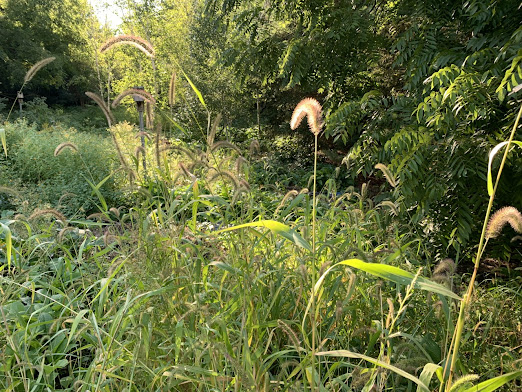
I’ll share a few photos I took there. I worry that many of us have lost the ability to experience the overwhelming awe that might halt our trajectory as a doom-bringing species. Mr. Smith is right: we are a—the—virus. Awe is the vaccine for our lack of care; reason is the vaccine for the prevailing western theology that reveres eternal abstractions rather than living presences. Most of us are vaccine refuseniks of one sort or another. 

Q: Is this notion of pairing poems something that is common across your work, or did this develop more recently? How do these paired pieces emerge?

A: A lot of poems take shape in clusters. It’s always been that way, as far as I recall. It’s just obsession playing out naturally. I’ve had the psalm idea or variations of it for years.

Q: I’ve always been curious at your suggestions that some of your poems take years to complete. Are these poems emerging out of ideas kicking around the back of your head that you finally write down, or notebook sketches you return to years after originally catching on paper? Or are these poems you are returning to repeatedly throughout a lengthy period?

A: I plod and plod. Plus work. Running my own business for—jeez, it was twelve years, I think. I’m hoping that my new employment will be somewhat less stressful. So far, it is. I am overwhelmed with gratitude that I don’t have to meet payroll during the pandemic. I might not have survived it.

So ... poetry. I’m a plodder. A poem or two may happen and just fall in place like an agreeably-shaped snowflake. Short ones happen that way. But I revisit too often. Little tweaks: add a breath here, take one away, record it, listen, strike-out, reshape. Then there’s the dialog between a poem and its neighbours. I notice threads that should be trimmed here, knotted there, woven.

Tools: notebook (preferred), decent pen, cell phone text to self, voice recorder.

Q: You say that a poem or two “may happen and just fall into shape,” but how are your other poems constructed? Are you assembling a collage of lines out of notebooks, or do those notebook-elements provide the foundation for a poem you will work to craft to completion?

A: Each poem requests its own rules for composition, I think. I’m purposeful after-the-fact, not in the act.

The Psalms are sonnet-like things. Their companion, more intimate duals or anti-poems are similar in structure but very different in tone.

The notebook is the repo for the draft. Sometimes, it’s prêt-à-manger, other times, the notebook has just a recipe on a scrap of paper with a rough list of ingredients.

Let me give you an example. I’m working on a long piece about GOERT, the Garry Oak Ecosystem Recovery Team and their project to preserve and revitalize these endangered sacred places on Vancouver Island. In my notebook, I have a few scribbles for what a line might look like. But the source is a spreadsheet on the https://goert.ca site. I had some scripts and things that I used to extract certain information. And I’m still in the process (about three years later) of shaping that into a poem that consists of micro poems for the species and their interactions. It’s a long-haul kind of thing. But when I have time to put energy into it, I love that kind of work.

Q: After a handful of poetry and critical titles over the past two decades or so, how do you feel your work has developed? Where do you see your work headed?

A: As strange as it sounds, my first published poems appeared four decades ago, my first book thirty-three. Crazy. Makes me nostalgic. My first book launch was at Gallery 101, I think, the night of one of Ottawa’s most intense earthquakes. I remember riding it out and thinking how interesting the sensation of that kind of jostling was and how it had a pleasing light rumble.

I don’t know if my work has developed. I’m not sure I understand what that means. It’s changed. I’ve become more concerned with the details of sound, the way a sentence grows over lines, the idea of a poem as overhearing. I respond; I don’t seek. I keep finding drafts of things that seem salvageable.

The work is wandering around happily undirected. A few ideas have occurred to me. The most promising one this week concerns naming. Names have enormous power, of course. In the poem “Mouth” that you published a while ago on periodicities, I mentioned the formal chemical name for the protein titin, a little thing you can’t move without. But it's not such a little thing—it’s the longest protein. It’s chemical name (a formula, really) is hundreds of thousands of letters long! Now, someone is going to have another name for it when they patent it—muscolene, or spandene—some commercial moniker to transfer to corporate ownership something your body produces.

This process is being reexamined in beautiful ways. But I think naïve ways. I have to be extremely careful here, because I’m no authority on the politics or linguistics of naming. But! The west has been erasing names for sacred things for so long we've forgotten how violent that is. If an Ojibway teacher were to cross out my names—Stephen Christopher Brockwell, names that shout privilege—with a name for what I am (Ojibway for old fart), how would I know myself? We have done this with purpose as a culture and continue to do it. We insist that others do it by creating a culture of conformity, to make people fit our existing categories. In my old neighbourhood, Langevin Street was renamed to Commanda Way after William Commanda, the leader from Kitigan Zibi Anishinabeg. How thrilling! But notice that the type of road is still English! His first name was William. We can’t think outside naming. I’ve been imagining very tender poems to objects, places, and people that have had, at times, no names, first names, translated names, appropriated names, imaginary past and future names. There are superb poets in our community who modified their names to be pronounceable or carry family names their parents homophonically translated into English.

So, yeah. Names. Fun. You won’t see a thread of the mumbo jumbo I just wrote in the poems, I hope.

Q: Finally, who do you read to reenergize your own work? What particular works can’t you help but return to?

A: Great questions! Local, global, newest, oldest. Brandon Wint’s book, Divine Animal, was wonderful. I don’t know quite how he manages to imprint reading instructions in his lineation. You read his poems the way he very carefully performs them. Ren Iwamoto seems to be doing wild, energetic things. She read a poem about body-building, ancestry, gender, sex—it was a singular piece that energized me. Nate Marshall’s latest book Finna is an interesting shift from Wild Hundreds that I found at the Chicago O’Hare airport. Such intelligent, thoughtful, musically diverse, and often deeply sensitive, insightful work. It’s a thrill to read. Working with Avonlea Fotheringham and Brandon Wint on the Tree Reading Series has been an education. The New York poet John Foy’s most recent book, No One Leaves the World Unhurt, is one of the most insightful, haunting, honest books of poetry I’ve read.

The return-tos! Fiction: Mary Ann Evans, Wayne Johnston, Katherena Vermette, David Mitchell, and Haruki Murakami. I find fiction restorative.

An ancient Greek phrase that was on mass-produced jewelry in ancient times has turned out to be from a poem. A lot of early poetry was irreverent, social, and sophisticated. We’ve talked about Catullus, Horace. Wonderful, witty, transgressive stuff. I revisit translations of Horace, struggle to read Francisco de Quevedo, struggle with Villon, Chaucer. I maintain the significance of Monty Python, Benny Hill, The Goonies cannot be understood without Chaucer.

I return to Coleridge. Such a decent, tortured human being. I return to Emily and Walt. I’ve been returning to Dionne Brand, Louise Glück, Erin Mouré, the recently departed Peter van Toorn. This sounds like a terrible name-dropping exercise. It is. But these are the writers I am learning most from.

For some reason—I think it was because Stuart Ross wrote something with 1687 in the title—I tried to return to John Dryden. Couldn’t do it. The music, the authority, the mastery of the lines does nothing for me. But I revisit Stuart Ross for many reasons. Insightful fellow. A meaning-schmeaning kind of guy I respect. I think I get to meaning from schmeaning; it’s important to embrace the schmeaning in a poem.

Tuesday, December 28, 2021

TtD supplement #205 : seven questions for Yoyo Comay

Yoyo Comay is a poet & musician from Toronto, Canada. He is currently working on a trilogy of long poems, the first of which is forthcoming from Vehicule Press in 2022, and is a founding member of the Toronto Experimental Translation Collective (TETC). He is also working on his debut album of original music.

His poems “habit is an atmosphere,” “this is ghost fishing” and “the world provides new metaphors for the body” appear in the thirty-first issue of Touch the Donkey.

Q: Tell me about the poems “habit is an atmosphere,” “this is ghost fishing” and “the world provides new metaphors for the body.”

A: These poems are all excerpted from a book-length poem called States of Emergency which will be coming out with Vehicule Press in 2022. This poem marked a new way of writing for me. Instead of sitting down to write a poem, which I had done in the past, but which often resulted in me just describing what I saw out of my window — tree, bird, cloud, bleh— I would write down lines, phrases, scraps of language as they came to me throughout the day. These would collect in a notebook and after a couple weeks I would stitch the fragments together into a chapter of this book. The result felt much truer to life, much closer to the texture of my experience. I stopped searching for “poetic” things to write about, and started collecting from everywhere — something I heard in a youtube video, or read in a biology textbook, a sensation I felt in my own body.

The content and language of these poems is representative of the book as a whole. I write from a pretty unconscious place. A phrase or word will pop into my head, and I’ll follow the language, the sounds of the words, and see how they unfold. It feels quite digestive, excretive, vomitous. I’m very frustrated by language, and I want to bring it as close as I can to the body, to moaning, to screaming, to the gut’s churning. I did have a pretty unsettled stomach when I was writing this poem, so I tried to see what words I could find in that roiling. I find the body and its breakdowns to be a very rich source of intuitive language.

Q: How do these poems relate to some of the other work you’ve been doing lately?

A: I was writing a lot of these long poems, using the process I described. And then I took a break from writing for a while. Now I’m trying to figure out how to write short poems again, and I’ve been experimenting with rhyme, which I’ve always loved. I started writing songs long before I wrote poems, so I’ve been thinking about how to integrate the two practices, to make the poems more song-like, and the songs more like my poems. I’ve thought about writing more long poems, but it feels like I’d be repeating myself or like I’d know what I was doing. I don’t like knowing what I’m doing when I write a poem. It’s usually a good sign if I don’t know if a poem’s any good. What connects these new sing-song poems and the ones I’ve sent you is an attention to sound. Sound, the musicality of language, is always my first consideration when I’m writing a poem. Maybe consideration is the wrong word. I follow sound, write the sounds that feel like they want to be written, even if I don’t know what they mean. This gives me a sense of the poem’s rightness. It’s often not very considered at all, or at least not thought out before hand. I have a hard time writing a poem if I know what I want to talk about.

It has to be an act of discovery.

Q: Do you have any models for the kinds of work you’ve been attempting? What writers or works sit at the back of your head as you write?

A: I don’t really consciously model my work after anyone in particular, although I’m sure the people I read come through in my poems. Yeats is always an influence, especially in some of the more metrical and rhyming stuff that I’ve been working on lately. For the long poems, Octavio Paz’s poem “Sunstone” has been quite influential to me, and is something I return to once in a while. And then the language of the Old Testament comes through as well. Some Shakespeare. Boring, obvious stuff. I guess the through line might be pieces of writing that take on a kind of mythic, incantatory tone. I recently started reading a lot of Walt Whitman. He had no direct influence on the book, but now that I’m reading him I feel a kinship.

But if anyone sits in my head, then they must be in a different room, or at least I have my back turned to them. I prefer to write in private.

Q: How has the process been of putting together a debut collection? Have you been attempting to hone the best of what you’ve done up to this point, or had you a specific project in mind?

A: I had a specific project in mind, although what that project was came together as I was writing. Again, I don’t really like to write towards something, I don’t like to have any idea of what I’m going to say before I say it. So the project was more based on the method of writing than it was on any specific content that I wanted the book to have. The method involved writing down lines throughout the day and then stitching these lines into chapters after a couple weeks. Interesting juxtapositions and patterns emerged in this way, and there was an element of chance and randomness involved. Things were said that I didn’t intend to say. Its a kind of semiautomatic writing I guess, where the unconscious reveals itself very slowly. I found myself repeating things, leaning on the same images and metaphors again and again, which was very interesting.

Q: How have you seen your work shift, if at all, through the process of putting together your debut? Are you yet at the point where you can see something else your writing might attempt beyond this collection, over that horizon?

A: My process shifted a lot when writing this book. I was writing more formalist poems before, and the book is a turn away from that, an attempt to bring more of my life, and more of ugly parts, into my poetry.

I think I need to try something else now that I’ve experimented extensively with this long-poem form. I think I’d know too much what I’m doing. I want to feel like uneasy when I’m writing, unsure whether what I’m doing is any good at all. Doing the same thing feels a bit safe. I need to be on the verge of embarrassment. There’s a lot I want to attempt. Narrative. Returning to formalistic writing. Experimenting with handwriting, drawing. Different surfaces.

Q: Tell me about your experiments with the long-poem form. What brought you to the form, and what did you feel you needed to accomplish through the process that the short lyric, for example, wouldn’t have been able to provide?

A: I was brought to the form by accident. I started collected lines for poems throughout the day, with the idea that I would then use these lines as seeds to write complete, short lyric poems. Then as a typed these disparate, discontinuous lines together I liked how they read as a single poem. So then I just kept composing like this, writing down scraps on the fly and it turned into a book. The one thing I knew, though, was how the poem would end.

I think the long poem, as I’m writing it, gives a better picture of the flow of life, going under then suddenly coming up for air, blinking the world into fragments. It felt closer to the way I was experiencing things. That being said, this long poem isn’t narrative or epic really. I’ve thought of it like this: a poetry collection is usually like a series of ponds. But this one is more like a river. That doesn’t mean you have to get in at the beginning and ride it to the end. You can jump in wherever and take a dip, feel the rush of the water going by. I think you could read it like a normal collection of poems. Or its like a social media newsfeed. Come have a snack, or glut yourself insensate. Your choice. Here I’ve given you some extracts from States of Emergency, and I think they work as stand alone poems as well.

Q: Finally, who do you read to reenergize your own work? What particular works can’t you help but return to?

A: I return to Paul Celan all the time, but I can’t read too much of him or else I’ll start to copy him. The gravity of that style can be too strong sometimes. I like to reread Octavio Paz’s long poem “Sunstone” once in a while, and I’m often surprised by how much of it has seeped into my poetry over the years. At the moment I’m thinking quite a bit about Emily Dickinson, Stevie Smith, WB Yeats. Poets who use rhyme and seemingly light-verse forms but have a dark and powerful undercurrent running through them. I’d like to write poems that get stuck in your head. I love the way that song lyrics can suddenly pop up in your mind and have almost epiphanic significance in the context of a new experience. I think rhyme and meter can give the reader a way to live with a poem over time, to keep it with them. And then what may at first appear opaque can slowly unfold, over the course of many years, or even a lifetime.

“Reenergize” is an interesting word to use. I sometimes feel more energized not by poetry but by pieces of writing that have totally different vocabularies than the ones I’m used to. I was taking an evolutionary biology course while I wrote my first book States of Emergency, and a lot of the unusual language that I found in the textbook for the course made its way into the poem. That experience was exciting to me, and I plan on mining other disciplines for new phrases and words in the future.

Monday, December 13, 2021

TtD supplement #204 : seven questions for Brandon Brown

Brandon Brown’s most recent books are Work (Atelos) and The Four Seasons (Wonder). He is an editor at Krupskaya Books and edits the zine Panda’s Friend. He lives in the Bay Area of California on unceded Ohlone land.

His poems “HOW I’M FEELING NOW,” “MY MENTAL HEALTH DAY” and “A SONG OF RAIMBAUT D’AURENGA” appear in the thirty-first issue of Touch the Donkey.

Q: Tell me about the poems “HOW I’M FEELING NOW,” “MY MENTAL HEALTH DAY” and “A SONG OF RAIMBAUT D’AURENGA.”

A: These poems feel in so many ways quite distinct, both in how they move and what they try to do, and the occasions for their coming to be. “How I’m Feeling Now” was written in response to a call by the pop composer and singer Charli XCX on the occasion of her 2020 album, How I’m Feeling Now. She was soliciting fan responses to the record, and I decided to take the challenge. Incidentally, it seems as if I didn’t make the cut, as I haven’t heard from Charli or her squad. “My Mental Health Day” was a poem that wrote itself in about five minutes late one night, and by contrast “A Song of Raimbaut D’Aurenga” was part of a translation I worked on at a very slow pace for most of 2020 and early 2021. Raimbaut left us 39 poems, and I translated his poems a stanza or two a day. D’Aurenga died in a pandemic in 1173, one of the first medical events called influenza.

For all of these distinctions, and to risk stating something very obvious, they all feel like poems of 2020 and Covid-19. From the delicious sweat of a packed club, to the sudden appearance of boss-endorsed “mental health days” at work, to the daily translation project enabled by spending a lot more time at home with my Occitan reference materials, I think of these poems as residue from that year and time, which of course doesn't feel concluded or over in any way.

Q: How do these poems relate to some of the other work you’ve been doing lately?

A: For the past several years most of my work has been in prose, and when the pandemic began, I had just finished writing a novel called The Tragicall History. But from the very beginning of Covid, I’ve struggled enormously to write in sentences. I don’t have a theory for why that has been the case, but to the great relief of my sanity I have been able to write poems and do translations. I’ve always been a writer with routines, and I’ve settled into new ones. As I said, Raimbaut D’Aurenga’s poems gave me a little bit of work to do every day, and I honestly feel grateful I had spent the year before the pandemic studying enough Occitan to be able to sort of read his writing. As for the poems, I’ve been obsessed with Joanne Kyger’s poetry in the past year, and I’ve tried to introduce elements of her approach into my own routines as a writer, savoring the time I make to work on writing and revising poems. But it’s still a quite different, for me, way of writing, to write poems without a project or overarching sense of the structure of the book in advance.

Q: What is it about Kyger’s work, specifically, that appeals? What of her approach or structures are you attempting to engage with in your own work, and how has that engagement been revealing itself?

A: Thanks for the opportunity to say more about Joanne!

First of all I want to recognize that I’m late to her work, for no good reason. I moved to the Bay Area in 1998, and Joanne was around, so close up in Bolinas, and I had a few chances to be in the same room with her and experience her magnificent big Scorpio energy. And plenty of people around me were advocates for her work, none perhaps more than my friend Cedar Sigo, who has been an amazing steward of her work, person and legacy. I just couldn’t find my way into her poetry, until I did.

I think what’s been most profound in reading her over the last couple of years is the quality and range of permission in her writing. Kyger’s poems are so often about what’s happening right now, whatever that is. Steam coming off a teacup, a negligible looking plant in the garden, a memory of something sweet or sour, a reflection on the essence of the fucking universe. She accommodates so much in her poems: her emotional and spiritual intelligence, her vast study, her friends and community in Bolinas, wit and savagery, grouchiness and pleasure.

I’m also deeply interested in her way of publishing, especially the many iterations of “Selected Poems.” These volumes are all distinct, aspire to select poems from differing periods of her writing career, and always include new work, but they often stretch back to her earliest writing. The number of these volumes relieve so much of the precious pressure on the tired, heroic “Selected Poems” form and feel so natural to how she approached individual poems, a steady alchemical blend of history and immediacy.

Q: With a handful of published poetry books and chapbooks under your belt, how do you feel your work has developed? Where do you see your work headed?

A: There’s a song I really love by the country musician Jake Owen called “Down To The Honkytonk.” The basic conceit of the tune is, I may not be rich, famous, well-respected, sophisticated, or important....but one thing is for certain: I’ll go down to the honkytonk. “I may not go down in history...but I’ll go down to the honkytonk.” I think one of the things that draws me to the song is this sense I have that poetry is an exercise in permission, play, study, collaboration with the living and the dead, and all of those things are also what you find when you go down to the honkytonk. It can also be risky (the nightlife ain’t no good life) and I hope that I continue to experience a little whiff of something like danger when I’m writing. Or at least uncertainty.

Q: What do you see as the value to uncertainty? How does uncertainty present itself in your ongoing work?

A: I think what I mean is I feel on guard against settling into one way of writing, especially a way of writing I learn how to do well, that becomes familiar and easy to do. I don’t want to write the same poem five hundred times, even if it’s technically a “good poem.” I’m most satisfied when I write something that initially makes me feel queasy about sharing it with someone else.

Q: I’m curious about your work as an editor at Krupskaya. Has being an editor shifted the ways in which you approach your own writing?

A: Well, I should say first that long before I was an editor at Krupskaya, the press was legendary to me. As a really young poet in San Francisco at the end of the last century, Krupskaya offered me a universe. When Jocelyn (Saidenberg) and Kevin (Killian) published my second book, The Poems of Gaius Valerius Catullus, I was constantly pinching myself to make sure it wasn't a dream. I know that sounds like hyperbole, but I really had “grown up” reading those books and intuited that the press and authors offered me a new and powerful direction for life.

I don’t know how to trace how my editorial work with the press has caused shifts in my own writing, but I guess I can offer a couple of thoughts. Especially when we had open reading periods, working with the press gave me the chance to read so many writers who were new to me, several of whom have become real friends since encountering their work. And then I’ve been given the chance to become obsessed with the titles we’ve published, living with them for weeks and months and years, absorbing them into my RNA or whatever it is. That’s certainly had an impact on my internal cadence and attention, and I’m really grateful for that.

Q: Finally, who do you read to reenergize your own work? What particular works can’t you help but return to?

A: Ah of course there are too many to list. When I return time and time again to something it’s often to try and study something very particular to the artistry of the work, usually because I’m trying to figure out how to do something in my own. I return to books to borrow their mood, to put myself in a mood. And in general I try to be as catlike as possible in my life as a reader: I know there’s food somewhere on this floor and I will fucking find it if it takes all night. And sometimes of course the thing I can’t help returning to is something I haven’t even read yet. But in the spirit of wanting to answer your generous question, if I’m stuck, and I am often stuck, but if I am really stuck, I think of Bernadette Mayer as a source of immense permission, study, prompt, and play, and her work has been a buoy for me countless times.