__________________________________________________________________________________________________________________________
__________________________________________________________________________________________________________________________
__________________________________________________________________________________________________________________________
__________________________________________________________________________________________________________________________

Wednesday, May 28, 2025

TtD supplement #277 : seven questions for Dominic Dulin

Dominic Dulin is a poet and musician out of Cleveland, Ohio. They have had poetry published by Iterant, Yum! Lit, Surreal Poetics, among others.

Their poems “E_nve_loped” and “Note on the Type” appear in the forty-fifth issue of Touch the Donkey.

Q: Tell me about “E_nve_loped” and “Note on the Type.”

A: Both of these poems come from the final section of my poetry book manuscript Double Time. I wrote the book during my MFA at Cleveland State University for my final thesis project. A million thanks to Caryl Pagel for being my advisor and being an irreplaceable mentor — if anyone reading this hasn’t read her work, you should.

Thematically, Double Time deals with doubling, repetition, and challenging/investigating binaries, among other themes. These poems also share those qualities with having near miss puns or direct puns in them. I also had a fairly strict line rule in the book where the poems doubled sequentially (and at a certain point in the opposite way), i.e. the first poem is in couplets, the second is in quatrains, third is in octets, and fourth is in sixteenths (which has its own fancy poetry word that is currently escaping me).

A good amount of the poems in the manuscript have glimmers of the work I was doing at the time. I had a dispatching job for hospital security and police for multiple hospitals, and while it helped me pay the bills for my fiancée and I, it eventually wore on my mental health and I became extremely burnt out. My dad is a cop and I never expected to do anything near the realm of law enforcement, and while I’m glad I know maybe a bit more than the average person about how things work in that (flawed) system, I will never do anything like it again.

For “Note on the Type”, I wanted to make a sort of anti-note poem. The Shona in the poem comes from me leafing through a dictionary and slowly attempting to learn my fiancé’s native language. A few other poems in the manuscript feature Shona and Japanese (both which I am still learning in my free time at various paces). My rule for — for lack of a better term — foreign languages, is that I tend to only want to use languages which I know or at least am attempting to learn, rather than plugging in a word from a language that I don’t know or don’t have some connection with. I love Joyce, but it seems that he may have done that at times in Finnegans Wake: plugging in words or phrases from other languages without fully inventing himself in them.

Q: How do these poems compare to some of the other work you’ve been doing lately?

A: Lately, I’ve been working on poems which are taking the form of sliced/fractured prose blocks. The first poet I read that had poems in that style is Franny Choi, who is a wonderful poet, but I’ve lately wondered whether another poet had crafted poems in the style first. I imagine the fractured prose block (as I’m calling it) has a long(er) history I’m unaware of. It seems a bit distinct from erasure poetry, which l’d imagine has an older lineage. There’s probably a Language Poet that ‘did it first’ I’m guessing. But I’m also currently interested in using forward slashes to break lines, even though the lines in the block aren’t actually broken, not unlike how a short group of poetic lines are quoted in an essay. If I remember correctly, Choi used colons, not slashes, to break up her lines.

Before that, I was working on a chapbook I’m tentatively calling “Face Notes: speak” which uses found language in a similar method I used with these poems. For both DT and FNs, I drew from line lists I either pre-wrote and let ferment, or had on hand. The main difference for the “Face Notes: speak” poems is that majority of the language comes from a text-to-speech app I was using while I was unable to talk after jaw surgery.

Q: I’m curious at the ways in which you are feeling out form. Are there other poets you’ve been attempting to learn from, for the sake of structure or approach?

A: I’d definitely say that J.H. Prynne has been a big influence. While I don’t think he always employs form in a visually obvious way, with his more recent text sequences, I do think he probably thinks about form a lot. Bruce Andrews is another poet which I’ve definitely been influenced by with some of my methods. David Melnick is another poet whose work I am infatuated with and have (hopefully) learned from. I also want to mention Oulipo — as a school of poetry I’d like to learn from — but I still haven’t dove into that realm even though my friend and poet Zach Peckham often mentions them in our conversations. Susan Howe and Hoa Nguyen are two poets I am always trying to learn from. Tristan Tzara (of course) and Bob Cobbing have influenced my interest in form as well. Catherine Wing helped me see form in a different and playful light, rather than in a wholly restrictive, outdated, or stuffy one.

To better answer how I’m feeling out form without name dropping more poets, I’d say that I’m always interested in doing something that involves numbers, experiments, and chance. Employing methods that involve various levels of (non-)control of the poetic outcomes. A sort of poetic fracturing, cut-up, or remix that resists form while still being (perhaps ironically) steeped in it.

Q: Perhaps it’s too early to get a clear sense of it, but how do you feel your work has developed? Where do you see your work headed?

A: I used to approach poetry with a sort of bleeding-heart, blood-on-the-page, Hemingway-esqueness coupled with a heavily Ginsberg influenced cadence. Surrealism also had a huge influence on me around 2016/17 and I felt that since then I was always trying to write, read, and figure out what “experimental” or avant-garde poetry was.

While now, I do in some ways have a better sense of it, I do see that I have gone from a more raw, bleeding-heart poetic approach to a more controlled and language-centered one coupling vulnerability with more “objective” or humorous/ironic language (my haiku practice likely also influenced this movement). As one of my former professors, Mary Biddinger, called it, rather than “bleeding on the page, now readers are seeing blood through the gauze” with my more recent poems.

Maybe I’ll head towards a synthesis of these bleeding-heart vs. language-focused poems or maybe I’ve already stumbled into a sort of middle ground. I think my future work could go either way, or maybe in a different direction, which I am also open to.

Q: What has been the process of attempting to shape a manuscript, and what have you been discovering through that process? Are there poems that don’t fit with the shape, or are you leaning more into a kind of catch-all?

A: I think since working on these poems for Double Time, in the Summer and Fall of 2023, I’ve thought a lot more about shaping a manuscript. Perhaps it’s because the manuscript was so rule based and number dependent — on top of the line sequences, each section had a certain number of poems, and the poems all add up to an even number as well — that I’ve since been more willing to cut poems from more recent manuscripts, where I was much less inclined to before with DT. I’d assume that more recent chapbook rejections have also played a role in this.

But overall, sometimes certain poems seem really good once you write them and place them in a manuscript but after a few weeks or months break and a return to them, they don’t land as gracefully as they did before. Perhaps I’m slowly becoming a better editor for myself and my manuscripts.

Q: Are you finding a difference in how you approach attempting to shape a full-length collection vs. a chapbook-sized manuscript?

A: I am finding a difference. I would say once I realized J.H. Prynne, for example, in recent years almost solely releases chapbook-length manuscripts (at an almost intense pace), it gave me some relief and freedom. The freedom to not sit and try to think about ‘what will the next book project be’ but instead think of smaller projects that I feel like I tend to have more stamina or excitement for at the moment. This is also why I sort of gave up trying to write fiction. It isn’t that I think I have a short or ruined attention span or anything but rather that I think I’m more interested in capturing something in language in the moment, or in a short(er) span of time, rather than something in the long term. I don’t doubt that that thinking could also change for me at some point, too; but for now, I tend to be more chapbook-focused.

Q: Finally (and you might have answered an element of this prior), who do you read to reenergize your own work? What particular works can’t you help but return to?

A: Hoa Nguyen, Louis Zukofsky, David Melnick, Lillian-Yvonne Betram, jos charles, Kobayashi Issa, J.H. Prynne — in no particular order. I can’t help but return to Hoa Nguyen’s Violet Energy Ingots, Melnick’s Pcoet, Lillian-Yvonne Bertram’s Travesty Generator, J.H. Prynne’s Orchard, and Zukofsky’s 80 Flowers. I’ve been meaning to return to charles’ feeld because it really floored me and caused things to click in me on multiple poetic and emotional levels the last time I read it but I think I’ve only read it once or twice.

Tuesday, May 13, 2025

TtD supplement #276 : seven questions for Misha Solomon

Misha Solomon is a homosexual poet in and of Tiohtià:ke/Montréal. He is the author of two chapbooks, FLORALS (above/ground press, 2020) and Full Sentences (Turret House Press, 2022), and his work has recently appeared in Best Canadian Poetry 2024, Arc Poetry Magazine, The Fiddlehead, Grain, The Malahat Review, and Riddle Fence. His debut full-length collection, My Great-Grandfather Danced Ballet, is forthcoming with Brick Books in 2026.

His poems “(Help Me Choose a Photo of) My Engagement Ring (to Post on Instagram),” “I Didn’t Call My Mother” and “Duplex Duplex” appear in the forty-fifth issue of Touch the Donkey.

Q: Tell me about “(Help Me Choose a Photo of) My Engagement Ring (to Post on Instagram),” “I Didn’t Call My Mother” and “Duplex Duplex.”

A: These three poems have disparate origins, but they’re all explorations of a kind of “queer mundanity” and a discomfort with “growing up” in homonormative ways.

I wrote "(Help Me Choose a Photo of) My Engagement Ring (to Post on Instagram)” for a Hybrid Forms workshop with Sina Queyras during my recent MA at Concordia — we were asked to bring in work to introduce ourselves, and this poem captured a lot of what I was writing and thinking about at the time. It will next appear in my debut full-length, coming from Brick Books in 2026. I wrote “I Didn’t Call My Mother” as part of a writing activity with my fiancé Guillaume Denault. And I wrote “Duplex Duplex,” which owes a debt of gratitude to the form’s creator Jericho Brown, as part of some sort of form-per-day challenge that Carlos Pittella shared with me — I don’t think either of us got past day two or three.

Q: How do these poems compare to some of the other work you’ve been doing lately?

A: These poems are a bit “lighter” than the work I’ve been doing lately. And they’re more grounded in the real and immediate domestic sphere. Lately I’ve been writing weirder, wilder stuff about (non-)reproduction that brings in a lot of animal facts I’ve had rattling around in my brain since I was a child.

Q: What prompted this shift towards a lighter approach, and how do those shifts reveal themselves?

A: For better or for worse (probably for worse), I almost always go into a poem with a “topic” in mind, and the topics of these poems couldn’t be taken too seriously. Maybe “light” is the wrong word. Maybe “seriously” is the wrong word. I guess I just wanted or needed the poems to be a little funny, to poke some fun at their domestic trappings, possibly to allow for some of the underlying emotion to exist within them.

Q: Do you consider this a shift in your writing generally, or more of an expansion?

A: Honestly, I hardly consider it a shift. More of a… modulation. I think humour/darkness/weirdness are each always bubbling under the surface of each of my poems, and I sometimes let one or more of them… come to a boil? Humour is particularly difficult for me to modulate. I’ve been told I use it to undercut emotion. I’m not how much of that is conscious.

Q: Do you have any models for the types of work you’ve been attempting? Any particular writers or works at the back of your head as you write?

A: Frank O’Hara, always. Danez Smith has been in my head a lot lately, especially after having had the pleasure of working with them at Banff earlier this year. And lately I’ve been thinking a lot about Nate Lippens’s writing, after devouring his two short novels My Dead Book and Ripcord.

Q: With two published chapbooks and a full-length debut forthcoming, as well as your current works-in-progress, how do you feel your work has developed? Where do you see your work heading?

A: I feel that I’ve moved away from try to engineer or engender a certain reaction (usually shock) in a reader. I try to give in to mystery and open-endedness, and to bring in more and more research-creation. I see my work, or at least I hope I see my work, heading to a place that is at once formless and accessible, that doesn’t fit neatly into any categories but can be relatively widely read and enjoyed.

Q: Finally, who do you read to reenergize your own work? What particular works can’t you help but return to?

A: Sorry for the delay on this last answer, I had to go to my spin class. (Do NOT edit this out. Your readers need to know that I am newly very into spinning.)

Because of my ongoing desire to “complete tasks” due to an obsessive, productivity-pilled mind, I rarely return to works. Am I allowed to admit that? I think Grease and The Wizard of Oz are the only movies I have seen multiple times.  Anyway — to reenergize my work, I read a poem from The Collected Poems of Frank O’Hara and use some element of the poem as a prompt. Also, I take workshops and studios to reenergize my work — I always love Sarah Burgoyne’s poetry studios, which have been immensely inspiring and productive for me. Recently, I took a great workshop with Susan Gillis hosted by the QWF, and I’ll be taking one with Jay Ritchie this spring. I also have a generative poetry group (with André Babyn and Sasha Manoli) and a workshop/reading group (with Madelaine Caritas Longman, Patrick O’Reilly, Carlos Pittella, Melanie Power, and Sarah Wolfson) and the work of all those incredible poets is always reenergizing. I also read non-poetic work to power my work — lately that’s been stuff like Queer Ecologies: Sex, Nature, Politics, Desire, edited by Catriona Mortimer-Sandilands and Bruce Erickson.

Friday, May 2, 2025

TtD supplement #275 : eight questions for Jordan Davis

Jordan Davis’s books include Shell Game (2017), Noise (2023) and Yeah, No (2023); he has edited several publications including The Poetry Project Newsletter, The Hat, Teachers & Writers, The Collected Fiction of Kenneth Koch, The Collected Poems of Kenneth Koch, the Apple iOS journal Ladowich, CCCP Chapbooks, several titles for Subpress Collective, and most recently a monthly publishing poetry on “Jewish-ish themes,” The Nu Review. He is also a former poetry editor of The Nation.

An excerpt from his “the book of how’s that going to work” appears in the forty-fifth issue of Touch the Donkey.

Q: Tell me about the work-in-progress “the book of how’s that going to work.”

A: I’ve had this notebook since the early 90s, absurdly thick cover, banana paper with threads and dirt-like imperfections in the surface, the absolute opposite of something too nice to write in, but not junk either, and I’ve carried it to five or six different homes thinking “someday I’ll know what to do with this.” That didn’t happen, so I wrote every wrong thing I could think of.

Q: How do these poems compare with some of the other work you’ve been doing lately?

A: These poems exist, which is a significant difference.

Q: Is utilizing the notebook the usual way your poems, and your projects, begin? How do poems move from notebook to completed?

A: It is. I get to the end of the notebook, and then I see what’s there.

Q: Do you see a difference in how poems emerge through working the notebook, versus any other process? And what other processes might you use to compose work?

A: Every notebook does act on my brain like a specific kind of container, and what I find congenial at one time may turn out later to be too confining or too expansive. Time is the real constraint — I use what I can find when the time emerges. Index cards… let’s talk about that another time.

Q: Did the shapes of your notebook pages inform the shapes of your poems? I’m thinking of those long, thin poems by William Carlos Williams, as he composed first drafts on his prescription pads.

A: These poems, yes. I want the work to be shapely but it’s the shape of the mental object I care about — the pathway of the experience of the poem. Other poems, the notebook acts more as a collecting plate, a radio telescope.

Q: With a handful of published books and chapbooks under your belt, how do you feel your work has developed? Where do you see your work headed?

A: I go where the thing I have to say is, but I haven’t liked to go where the things I dislike are. I’ll probably have to wade into what I dislike now. And there’s so much to dislike.

Q: I’m curious as to what some of that “wading into what you dislike” might look like, and what the process and results might be. Should I even ask?

A: I see a lot of a willed kind of poetry — self-seeking, self-mythologizing… often pretty but in a way you see coming. It clearly serves a need, but at the expense of deeper needs, in my opinion.

Q: Finally, who do you read to reenergize your own work? What particular works can’t you help but return to?

A: Poetry, if it’s any good at all, is for rereading. I’ve been rereading Kenneth Koch; it was just his centenary (February 27). I find something new every time I read him. For me, editing books and chapbooks by other poets is a form of rereading that helps me see what I want better. What renews my love of poetry, or rather, what gives me the feeling I enjoy most, is to find new poets I want to reread.

Tuesday, April 15, 2025

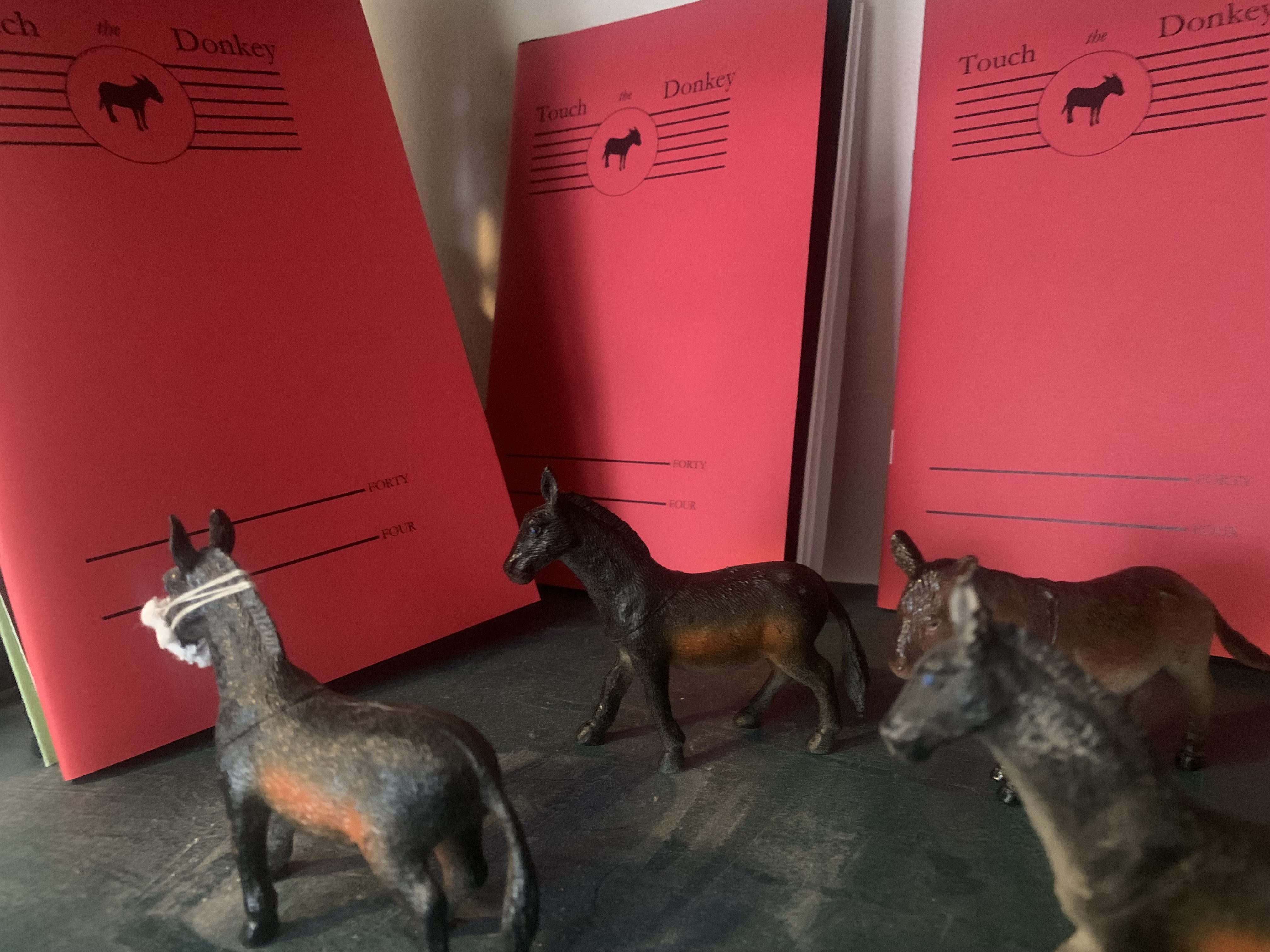
Touch the Donkey : forty-fifth issue,

The forty-fifth issue is now available, with new poems by Dag T. Straumsvåg, brandy ryan, Misha Solomon, D.A. Lockhart, Dominic Dulin, Lea Graham, Jordan Davis and Larkin Maureen Higgins.

Eight dollars (includes shipping). You might remember me from such dates as last night's dinner.

Thursday, April 3, 2025

TtD supplement #274 : seven questions for Alice Burdick

Alice Burdick writes poetry, essays, and cookbooks in Lunenburg, Nova Scotia. She is the author most recently of Ox Lost, Snow Deep (a feed dog book/Anvil Press), and of Deportment, 2018, Wilfrid Laurier University Press, Book of Short Sentences, 2016, Mansfield Press, Holler, 2012, Mansfield Press, Flutter, 2008, Mansfield Press, and Simple Master, 2002, Pedlar Press. Her practice often includes collaboration, and recently her poetry has been used in Woodlight, a series of three films created by Hear Here and Erin Donovan. Her poems have appeared in Aubade: Poetry and Prose from Nova Scotian Writers (Boularderie Island Press, 2018), GUSH: Menstrual Manifestos for Our Time (Frontenac House, 2018), Surreal Estate: 13 Canadian Poets Under the Influence, An Anthology of Surrealist Canadian Poetry (The Mercury Press, Fall 2004), as well as other anthologies. She is the author of many chapbooks, folios, and broadsides since 1991. Her essays have appeared in Locations of Grief: an emotional geography (Wolsak & Wynn, 2020) and My Nova Scotia Home: Nova Scotia’s best writers riff on the place they call home (MacIntyre Purcell Publishing Inc., 2019). She has authored three cookbooks for local publisher Formac Publishing. From 1992-1995, Alice was assistant coordinator of the Toronto Small Press Fair, and has been a judge for various awards, including the bpNichol Chapbook Award.  She is also a freelance editor, manuscript assessor, and workshop leader.

Her poems “Little envelope,” “Ancestry, a small corner” and “All the faces” appear in the forty-fourth issue of Touch the Donkey.

Q: Tell me about the poems “Little envelope,” “Ancestry, a small corner” and “All the faces.”

A: Sometimes poems have specific origins and sometimes they don’t. And sometimes I can remember where they started and sometimes I can’t! I think “Little envelope” came from thinking about the witching season and how the idea of haunting is related to memory and trauma. And then it went to accepting the chaos of possibility. “Ancestry, a small corner” is based on a moment during a trip to visit my ancestors’ neighbourhood in the Bronx, and the connection to place but concurrent inability to know what might be called the whole truth. “All the faces” came from a prompt upon viewing Hannah Hoch’s collages and then followed my own brain’s collage of thoughts about existence, birth, community, erasure and absurdity. I like to keep it light and heavy.

Q: How do these pieces compare to some of the other work you’ve been doing lately?

A: They are definitely in the same realm – ie writing about memory, family histories, representation and imagination. I want to always play with lines because that aspect of writing, even when it is heavier stuff, is highly enjoyable.

Q: Is that a main function of how your poems get built, the movement of playing with lines?

A: I would say that there is a logic that reveals itself in the making of the poem through the lines, and the structure and conversation of lines and stanzas. I relate it a lot to improvisational music, where something is formed through that play, even if it is serious. I have to not know where it is going. But I definitely know that that is frustrating to some readers! That’s okay.

Q: How did you evolve into working this kind of poem-discovery? Too often readers claim to require a narrative logic, but your work actively resists that (in the most marvellous of ways, I’ll add). How did that come about?

A: Thank you! I think at a certain point, reading a great variety of poets and listening to a swath of musicians and taking in the wide world of art and performance, I realized I could be influenced by all these but not need to imitate anyone specifically. Also, although I appreciate when others receive my work well, I don’t think I’ll receive great riches or fame etc from it, so that in itself is somewhat liberating.

Q: With a handful of published books and chapbooks over the past three-plus decades, how do you feel your work has developed? Where do you see your work headed?

A: I think over time I’ve become more comfortable with the weirdness of my writing and so the writing shows that. There are more long poems and sequences. I also see the performing of the work as an increasingly integral way of receiving it, and this is because the music of words and sounds is much more a thing I invite into the work. So I’d like to maybe record performances and do more live ones, with musicians.

Q: You’ve produced three cookbooks over the years. How does this work connect to your literary work, if at all? How does one approach writing a cookbook after decades of writing and publishing poems?

A: The cookbooks are a separate venture. I definitely use editing skills in the recipes as a lot of the ones I’ve addressed have been historical recipes using earlier methodologies and measures in some cases. So in a practical sense they use form, which I know about but don’t use in a straight-up way in my poetry. The closest relationship the cookbooks have would likely be to my essays, in that they are “real”. I enjoy the cookbooks because they are a form of my work that is truly popular and people aren’t as afraid of recipes as they are of poems!

Q: Finally, who do you read to reenergize your own work? What particular works can’t you help but return to?

A: I particularly love New York School poets and Modernists. Give me something spare and give me something rambling. Give me something very personal and give me something very imaginative! Do wild and simple things with language! Lorine Niedecker, Edmond Jabès, Bernadette Mayer, Frank O’Hara, Nelson Ball, Marina Tsvetaeva, Charles Olson, Ron Padgett, Emily Dickinson. These are some of the folks I return to!

Thursday, March 13, 2025

TtD supplement #273 : six questions for Austin Miles

Austin Miles is from southeast Ohio. He is the author of the chapbook Perfect Garbage Forever (Bottlecap Press) and has poems published in Reap Thrill, Don’t Submit!, and elsewhere.

His poems “Authorial domain of the representative,” “Risky, not to mention boring,” “your reputation is good but your shit is shit” and “Makes nonsense” appear in the forty-fourth issue of Touch the Donkey.

Q: Tell me about the poems “Authorial domain of the representative,” “Risky, not to mention boring,” “your reputation is good but your shit is shit” and “Makes nonsense.”

A: I wrote these pieces when I was working for a small nonprofit. So they’re conditioned by work, but mostly they’re not about work. I am talking nearby (Trin Minh-ha’s term) white collar nonprofit work. I am talking about everything work is not but which work suffuses. Incoherent words about leisure tentatively approach the enigmatic lurking beneath a mission statement. And then sometimes indirectness is broken by a lapse into the direct. But that can be useful.

Q: How do these pieces compare to some of the other work you’ve been doing lately?

A: I haven’t been writing lately. But I can tell you about the difference between the poems I sent you and the ones I wrote further down the line. The poems you published are inspired by a job and cobbled together from notes I wrote each day about that job or whatever was going on in my life—once I was done being interested in work I got interested in a lake. That produced some big differences. I think incoherence is a throughline here (for better or worse) but the incoherence of the lake poems was more of a matter of decay and garbling than diaristic bricolage. After a period of piecing together jumbled messes, I decided to try sitting down and just writing them straight out.

Q: What prompted you to write daily about work, “or whatever was going on,” as you say?

A: Can’t help but turn to your freshly published essay in Coma to answer the question. First off there’s the “unanswerable why” from the quote you draw from the interview with Sarah Gerard in the Chicago Review of Books. Gerard thinks up the “unanswerable why” to describe what a good story has, but I’m nicking it to describe writing (or anything at all). Why write? There's always something that explanation can’t get at.

But more importantly, you describe writing in that essay as “a way through which to articulate, argue, document and process,” which is more or less what writing is to me—another way of thinking. I’d been reading critiques of nonprofits (most importantly The Revolution will not be Funded), felt ambivalent about my own work, and writing was a way of getting at what I wasn’t getting at, or arriving somewhere else (someplace a little off to the side).

Q: Have you any models for the kinds of work you’ve been attempting? Any particular poets or particular works at the back of your head as you write?

A: No models, no one at the back of my head, but I wouldn’t claim I write from a vacuum. John Berryman was an early favorite of mine, probably set me on particular paths, as opposed to other ones. Lorine Niedecker is a current favorite. Frank O’Hara, A.R. Ammons, William Carlos Williams, Wendy Trevino, Jenny Holzer, James Wright all do/did things I think I draw on at some level. I also read plenty of lit journals, and feel like there’s some kind of creative writing habitus floating in that lit journal ether subliminally shaping my writing.

Q: What are your go-to literary journals these days?

A: Lately I’ve been enjoying Mercury Firs, Annulet, Grotto, new_sinews, the poetry the Cleveland Review of Books posts periodically, and Coma. That’s just lately—there’s lots more out there.

Q: Finally, who do you read to reenergize your own work? What particular works can’t you help but return to?

A: The poets I mentioned above are an okay start. I often reread Niedecker’s Paen to Place, and also Lake Superior, and My Life by Water—I have a book of her collected works. Gary Snyder’s Riprap and Cold Mountain Poems also. Or I’ll just pull something off the bookshelf, whatever draws me from my little collection. I’ve recently pulled down Madison McCartha’s Freakophone World, Nicole Cecilia Delgado’s islas adyacentes, and Frank O’Hara’s Meditations in an Emergency to read some poems or just one, or just a few lines. I think the returns that surprise me are often more refreshing or whatever than reaching for the old reliables. And then looking to what people are doing outside poetryland is important as well. I recently started a PhD program in Anthropology and have found all the readings we do to be really generative for instance. On the other hand I don’t have any time to write my dumb little poems anymore—but maybe that’s a good thing.

Wednesday, February 26, 2025

TtD supplement #272 : seven questions for Jennifer Firestone

Jennifer Firestone is the author of five books of poetry, including Story (Ugly Duckling Presse). She is the co-editor with Marcella Durand of Other Influences: An Untold History of Feminist Avant-garde Poetry (MIT Press) and with Dana Teen Lomax of Letters To Poets: Conversations about Poetics, Politics and Community (Saturnalia Books). Firestone is an Associate Professor of Literary Studies and Chair of Writing at the New School’s Eugene Lang College.

Her four poems “From Dream Sequence” appear in the forty-fourth issue of Touch the Donkey.

Q: Tell me about the poems included here as part of “From Dream Sequence.”

A: Dream Sequence came from what I consider a failed poetry project. I was part of a poetry salon run by Kimberly Lyons during the beginning of Covid. At the time I felt that my dreams were colorless. In fact, I don’t remember most of my dreams during this time period. Nevertheless, I needed to bring a poem to this salon and I brought a few pages from a dream I remembered. In the dream I was shoplifting, driving around lost, and then suddenly aware that I was teaching a class that I barely ever showed up to. I realized, as I had before, that my dreams were the same old anxieties and fears manifested into “night narratives.” I was a bit humbled by how simple I seemed.

My family loves to share dreams. I try to be a polite audience but I tend to lose interest. Is the reportage of dreams a low-level version of narcissism? From there Dream Sequence took off. Like most of my writing, the work typically evolves from resistance and perplexity. I began to write less about my dreams and more about the act of dreaming. What are the best “conditions” for a dream; is that such a thing? What happens when dreams are blurred with domestic noise and outside interruptions. Can I steer my dreams away from panic and cowardice and more toward desire and potential?

Q: How do you consider this project failed?

A: So the original project (hopefully not this iteration!) I felt failed as it was too self-conscious; I felt my hand in it. I think I was relying on the substance of my dreams to carry the poems, to do its magic and I’m not sure that’s as exciting for the reader as it is for the writer. The surrealists did a good job with working with dreams, so did Bernadette Mayer, Alice Notley and many others. But it felt a bit surface to me; it lacked tension. I put these dream-poems away for a year and then came back again and realized I needed to bring in my critique, my doubts along with my dreamworld in relation to the material world. As Rachel Levitsky said to me after hearing me read some of these poems at Familiar Trees, wow a dream writing project that doesn’t include dreams.

Q: How do these pieces compare to some of the other work you’ve been doing lately?

A: My other work right now is more documentary/investigative. Dream Sequence is a series that includes some research about the mechanics of dreaming and other writers’ perspectives about dreams but it’s not as project-oriented. In Dream Sequence I developed a persona who is somewhat unpredictable and subversive. I see the speaker as an anti-heroine of sorts. I’m also playing with the echoes of more traditional romantic poetry, with elements of the rhyme and diction, but transposed to the contemporary time period.

Q: You mention that most of your other works are project-oriented. What brought you to moving through project-based works?

A: I appreciate the grounding of a project-based work but at times the research and approach can feel similar to some of my more academic work. Dream Sequence feels a little more slippery, surprising. I’m not sure where it’s going to end up. Perhaps it’s like dreams where you don't know when they will come to a sudden stop and what the feeling might be that remains with you. Since I’m chairing my department right now and overwhelmed with work and the state of our country and the challenges my family faces, I needed something that could possibly address these various stressors but also be playful and suggestive and beguiling. Additionally, I tend to be restless and contradictory, so if I take on a particular writing approach or aesthetic I tend to abandon that the next time around.

Q: With a handful of published poetry titles under your belt, as well as your current works-in-progress, how do you feel your work has progressed? Where do you see your work headed?

A: Ah, “progression,” I think that can be a tough word in relation to one’s poetics as poetry/being a poet resist a linear trajectory. I just know that each of my books has some correspondence with the last one but also steps into a different direction formally and topically. I care less and less about trends and hold myself more to my own integrity: am I being too surface? Have I pushed the language? Who is the work speaking to? How does it move from my own habits, affinities and obsessions and reach to the unknown and defamilarized? Does my craft and form meet the needs of the subject? Am I including the broader world versus my own little microcosm? The questions go on. Being a poetry professor for over twenty years, along with participating in several editing projects, have made me more critical, word for word. My students know that I won’t hold back when offering critique. At the same time, I’m not about the “workshop poem,” and can fully embrace a messy, disjointed poem if that’s what the work wants to do. I think as you get older you become more aware of time so for me it’s not just about publishing, it’s about what I can offer that might be useful, joyful, interesting to others. I have many aspirations as I think about future projects. I want to keep exploring subjectivity and language-making as that is what informs our consciousness and awareness in relation to others. I want to continue using the vehicle of a camera and in extension, photography, as a way to investigate framing and perception. I want to keep including animals and plants in my work. I want to keep an eye to what is marginalized and devalued as that is where we can learn and understand systems, preferences and biases. I want to work with a traditional form and see how that will influence my poetics. I want to write long Ashbery-like prose blocks as I love his work very much. I have fallen back into essay writing (last year I created and taught a new course entitled The Poet’s Essay), and hope to write a book-length creative nonfiction about my father’s death but more so about my cultural concerns regarding rituals of grief. I might write a strange play. I am always thinking up new ideas. I also have done numerous collaborative projects and will probably do more. If only I didn't work full-time and have three kids. . .. but this is my life.

Q: Through your creative and editorial work, I’ve long had the sense that much of your writing exists in conversation with other writers and works. You mention John Ashbery; what other poets and/or particular works sit at the back of your head as you write?

A: I would say my writing is in conversation with my friends’ work. I feel very fortunate that I’m in conversation with many brilliant writers such as Brenda Coultas, Erica Hunt, Marcella Durand, Evelyn Reilly, Karen Weiser, Cole Swenson, Kimberly Lyons, Albert Mobilio, Anselm Berrigan, Lee Ann Brown, Tracie Morris, Hoa Nyugen, Pam Dick, Anne Tardos, Anne Waldman, Sarah Rosenthal, Eléna Rivera, Wendy, Xu, Tonya Foster, Dana Teen Lomax, Rachel Levitsky, KPrevallet, Julie Patton, Carla Harryman, I’m leaving off many more whom I adore. I think friendships can be overlooked, like you should first scan your bookshelves versus who is breathing besides you. My recent MIT Press collection, which I co-edited with Marcella Durand, Other Influences: An Untold History of Feminist Avant-garde Poetry, subverts the concept of influence. When you are deeply engaged with others’ writing to the point that the writers form your communities you can’t help but be influenced by them in your own writing. I don’t want to name particular works here as I tend to resist iconization of my favorite books. I am also fickle. I read toward my mood and need. Sometimes Stein is the perfect antidote and sometimes she gives me a headache. I have a genuine curiosity and generous attention to lots of diverse work. Although I tend to write what would be labeled as “experimental,” I’m quite open to various kinds of writing. That’s probably what makes me a good professor and reader of works, as I try not to let my own aesthetics entirely govern my reading practice. I like work where there’s a pressure on and attention to the language, where exploration of the subject and form is self-aware, nuanced: this could be Matsuo Bashō Wanda Coleman, Wallace Stevens or Susan Howe. I also like meaning to be just out of reach—when a poem has intention to some degree but perhaps doesn’t know its full sweep, where I can feel its thinking and struggle.

Q: Finally, who do you read to reenergize your own work? What particular works can’t you help but return to?

A: Again too many to list but I’ll try. Rilke’s Duino Elegies, Paul Celan’s Breathturn and Threadsuns, anything Ashbery, Myung Mi Kim’s Dura and Penury, Bernadette Mayer’s Midwinter Day, anything Lyn Hejinian and particularly her lecture, “The Rejection of Closure,” Rachel Blau Duplessis’s Drafts, her writings in The Pink Guitar, Emily Dickinson, anything Harryette Mullen. I’ll cut myself off here.